Removing water from your thermal system is a task that requires precision: every cold start and every issue with pump cavitation or pressure fluctuations must be addressed on the assumption that there is water present that needs to be removed if the system is to continue functioning properly in the long term.
Simply running the pump while slowly raising the liquid temperature is not enough: the water does not disappear, but merely finds a new place to hide.
Many heated systems have a separate deaerator to separate gases from the liquid. This is effective for non-condensable substances such as air or nitrogen, but not for
substances that can condense, such as water.
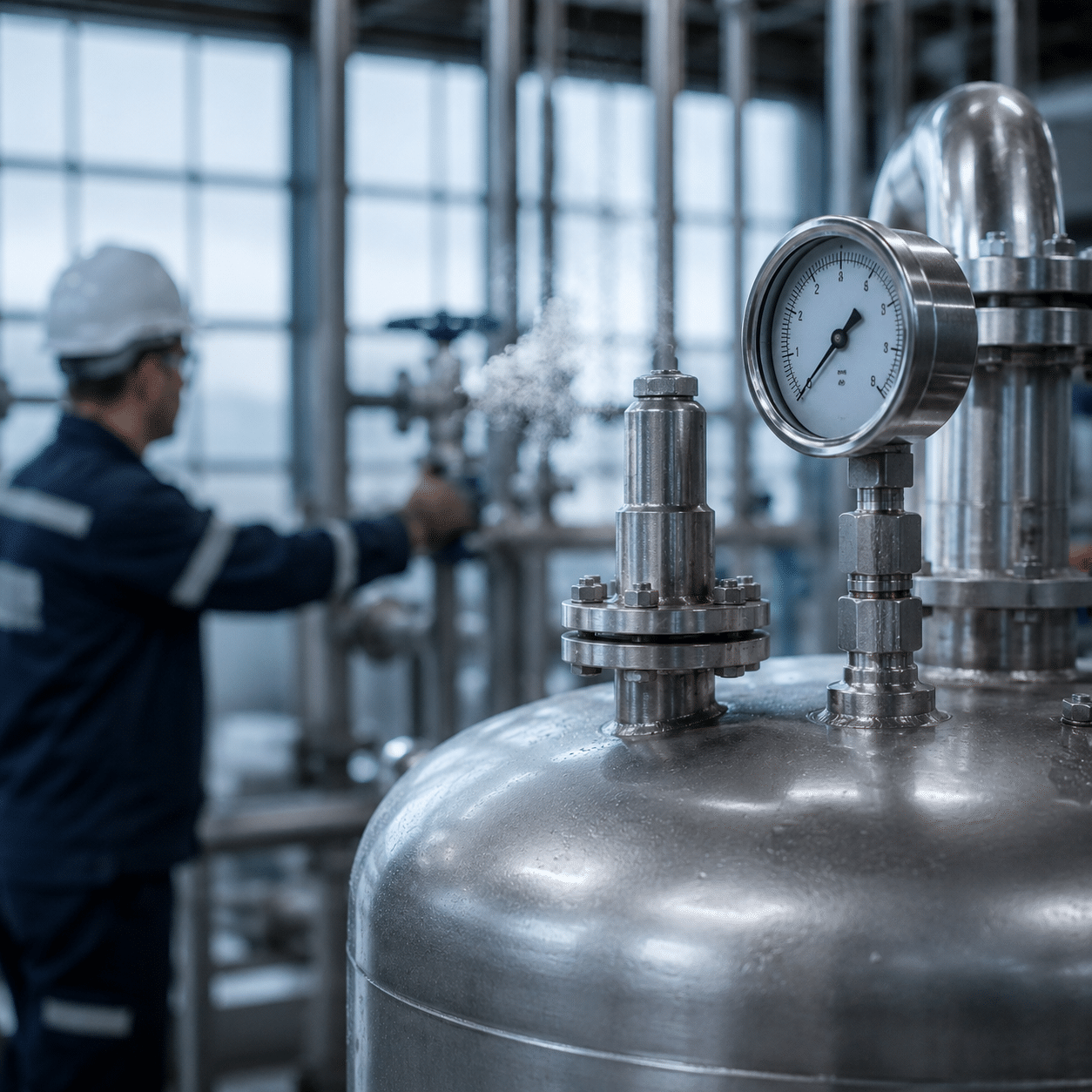
Water vapor must be able to escape into the atmosphere, and the only place in the system that allows this is the expansion tank. The key to removing all the water in the shortest possible time is to ensure that the temperature of the expansion tank remains above 100°C, so that the vapor does not condense again. Every drop of steam that condenses back into the liquid increases the time needed to fully blow out the system. Insulation blankets over the top of the expansion tank keep the walls of the headspace warm, and a small nitrogen purge helps sweep water vapor out of the tank while also preventing liquid oxidation.
Does your heating system have a heating line that connects the heating system’s outlet to the expansion tank? If so, open this valve, along with the manual bleed valve on the tank. If your heating system does not have a heating line, consider having one installed. Next, open the control and shut-off valves on each loop to ensure you don’t miss anything, and check that the overflow tank is empty.
Slowly increase the heating temperature to 107°C and check for steam and pump noise. If everything goes well, increase the temperature in 3°C increments, checking each time and allowing the system to stabilize. Repeat this until the system is stable at a pump suction temperature of 121°C—this temperature is the determining factor, regardless of the heating system’s outlet temperature.
Always shut off the heating line before putting the system back into service. If your system has an air vent with a thermal buffer tank, check to see if it has a drain valve to remove the accumulated water; if not, have one installed. Are you unsure whether your thermal system contains water, or do you want to be certain that the drainage process was successful? An oil sample analysis from Rodun International provides immediate insight into the water content and condition of your thermal fluid. This helps you prevent unnecessary downtime, pump damage, and pressure issues, and keeps your system operating safely and efficiently. Our consultants are happy to work with you to determine the right approach for your specific system, from a one-time inspection to a comprehensive maintenance plan.
A comprehensive and growing product portfolio